
Do Educational Institutions OWE us a Feeling of Belonging?
This question emerged during a recent conversation with Dr Tom Ritchie, founder and co-lead of the Centre for Belonging in Education.
An institution can be defined as an established organisation, structure, or social practice that serves a public purpose, shapes behaviour, and creates lasting patterns in society. So what, in theory, do they owe us compared to "nice to have"?
Because institutions are designed to endure rather than exist temporarily, their operating logic - particularly in education - has often prioritised the “head” over the “heart”: longevity over humanity.
This thought piece argues that such an approach is, in many ways, upside-down. Increasingly, we are seeing the deleterious consequences - both financially and in terms of mental health.
What has evolved is a pattern of applying "sticking plasters" to what is, in reality, a much deeper wound. A wound, where if it were to be properly tended would in fact best ensure longevity of the institution.
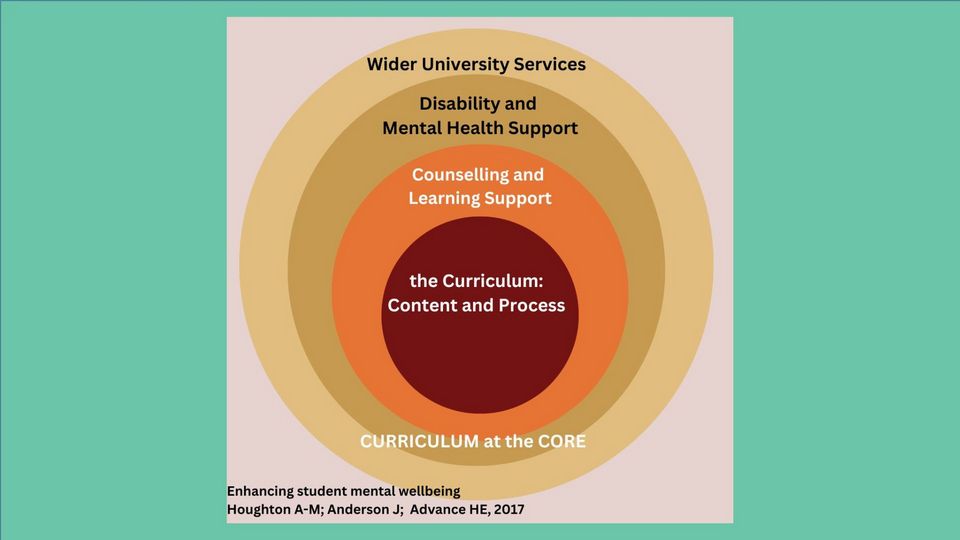
These “sticking plasters” take the form of counselling services, learning and disability support, and wider university provisions. While valuable, they often fall short of what is needed, but also place growing cost burdens on infrastructure outwith the core activity of Teaching and Learning.
So what if we flipped over our thinking?
What if, instead of focusing primarily on support structures around education, we re-thought the content and processes of the curriculum itself?
Research such as Houghton and Anderson (2017), Embedding Mental Wellbeing in the Curriculum: Maximising Success in Higher Education, points in this direction, where findings revealed how curriculum design is the most important direct influence on student mental wellbeing and success.
This raises a deeper question: what would it take to move away from the traditional “banking model” of education - where knowledge is deposited into learners irrespective of their predilection - towards an approach that fosters deeper learning, self-discovery, meaningful purpose, and shapes behaviours that will most contribute to society, such as any insitution would aim to do?
When something appears complicated, invariably we know we have the answer when it deceptively, eye-wateringly simple. — In this instance, the solution lies in how to live as a humane human.
If we are homo sapiens, then Belonging matters at our core. It is rooted in our biology. Proof of this is that where learning environments are intentionally designed to be “brain-friendly” in this way, it has been proven as supportive to both cognitive functioning and academic outcomes. It has been said, education only begins when a learner looks at a teacher who looks back at them with a smile in their eyes.
If educational institutions are to be genuinely fit for purpose, then curriculum design and delivery must be humanised in ways that nurture Belonging. This is not something that can simply be “taught” through a checklist of behaviours. If it were, artificial intelligence could easily replace us.
So what is the “human ingredient”?
At a fundamental level, all people share the same basic needs - experienced as feelings - that must be met for us to develop and flourish. The biology of our human brain is designed such that only through the experience of these feelings do we feel fully ourselves.
“Belonging” is one of the most powerful ways to describe when these needs are being met.
Closely related is the idea of Trust, which can serve as a useful indicator of whether Belonging is present or absent.
But it's important to adhere to the fact that Belonging cannot be delivered through training alone. It does not work that way.
Through our values-based approach within LifeRoute and also its Caring on Campus initiative, we share a simple five-component framework of needs. It is used where we engage in ongoing coaching/mentoring style engagements with individuals and institutions, to deepen awareness and clarity around how environments can be shaped to enhance what is the life-giving experience of Belonging - for both themselves and for others.