
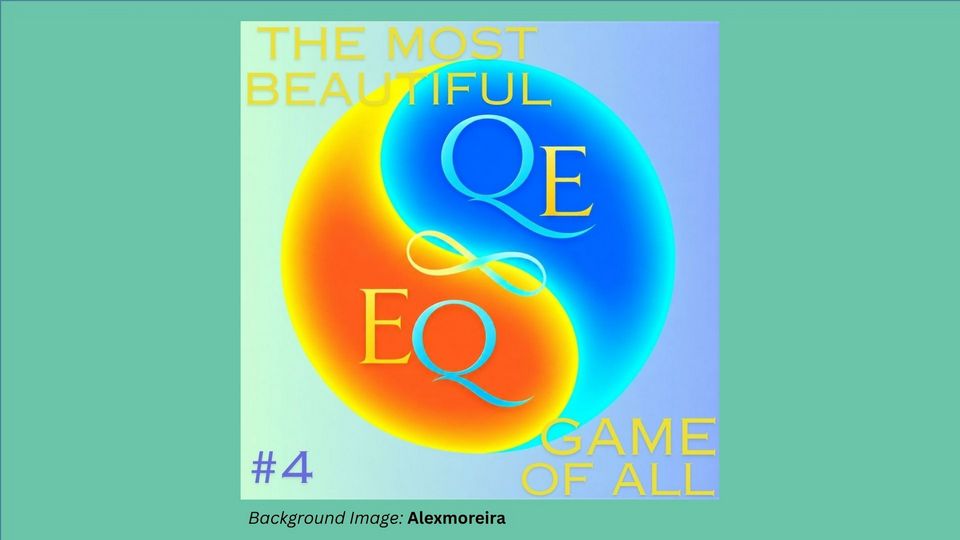
Quality Education (QE) and Emotional Quotient (EQ) are like conjoined twins. Can they be separated and survive independently?
To LifeRoute’s way of thinking they co-exist like yin and yang.
What brings quality to education? It used to be knowledge that wasn’t otherwise easily acquired.
Where that knowledge was inculcated and lived, it became wisdom: the ability to fast-track learning through the added benefit of the educator’s experience without having to learn everything the hard way.
But knowledge has become almost commodity in terms of accessibility. “Knowledge does not keep any better than fresh fish.” It can become outdated as fast as yesterday’s newspaper. Technical skills, too, can lose significant value remarkably quickly as technology advances.
It’s time to fully recognise that one of the most important – and least easily replicated – assets of any organisation or institution is its people. Not simply for their knowledge, but where the enduring quality of their education is the enhancement of life skills that involve emotional control and self management, together with the ability to relate to others and to sustain positive social connections. In other words, their level of emotional intelligence.
The more powerful our AI tools become, the more important it becomes to cultivate these distinctly human capabilities.
Otherwise, in the absence of intentional development of EQ as a key component within QE. we risk developing increasingly intelligent machines while leaving the development of human consciousness – and our collective future – largely to chance.
As the New Statesman (Phil Tinline) observed:
“For a generation who have grown up with technology invading every corner of their lives and heavily indebted from university, unable to afford their own homes, the technological revolution looks less like an exciting new toy and far more like another threat to their agency, quality of life and the society they want to live in.”
This is where Emotional Intelligence matters.
A widely used model of emotional intelligence identifies five core capabilities:
– Self-awareness: recognising our own emotions, moods, feelings, and how they influence our thinking and behaviour
– Self-regulation: managing impulses and tendencies so that they support rather than undermine our intentions
– Motivation: drawing on what matters to us in order to pursue meaningful goals and persevere when things become difficult
– Empathy: understanding other people’s feelings and perspectives
– Social skills: communicating well, building strong relationships and working constructively with others.
These are not soft accompaniments to life and work success. They are distinctly human capabilities where our response to AI needs to be that it necessitates for us to explicitly now cultivate them.
It has to become a vital part of the infrastructure of QE to develop high EQ so that AI amplifies the quality of human input – that includes our criticality, creativity, collaboration, problem-solving, judgement and ability to make principled decisions that can steer us towards a quality collective future.
Why? Because AI doesn’t operate in a vacuum. It operates through people.
Therefore AI is not simply a technological challenge, but is a prompt to up our own game.
The humane game.
This is the Beautiful Game that all of us are now being invited – perhaps even obligated – to play: the game in which we reconsider what we mean by intelligence and ultimately what education is for.
Elon Musk’s response to the accelerating development of AI has been in effect, to “Just enjoy the ride.” But perhaps that is the very question we need to ask ourselves, rather than be accepting of it.
Do we really want simply to enjoy the ride? Or do we want to become better players?
We have arrived at the point of making a stark choice: do we let our future become defined by how intelligent our machines become, or on how consciously we choose to develop ourselves.