
As our thoughts evolve there comes the realisation that to play the beautiful game beautifully takes the power of concentration.
Concentration grows stronger the more we use it.
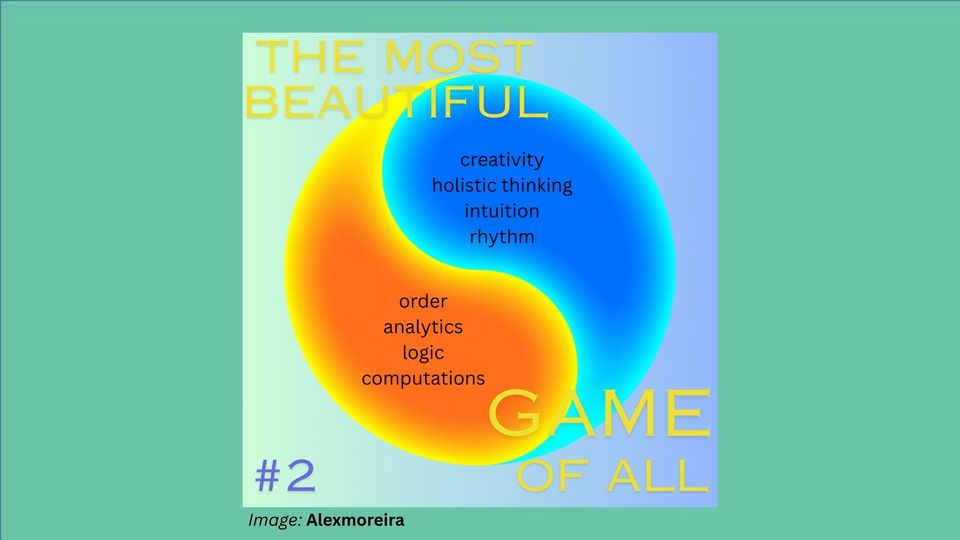
We often hear people described as either “right-brained” or “left-brained” – one intuitive and imaginative, the other analytical and practical. Yet both hemispheres of the brain are within each of us: it’s a matter of how those capacities are cultivated.
The curious thing is that neither concentration nor those capacities seem to flourish through strain. Strain conjures up the image of the right and left hemispheres of the brain pulling against each other: each trying to dominate at the cost of the other. The harder we force, the greater the escalation in tension. We have even come to apply the terms ‘stress’ and ‘tension’ beyond the contexts of physics and engineering, and use it to describe the state of our mental and emotional wellbeing.
In the first piece we explored life as a game to be played. Here, attention becomes part of that game.
When attention is relaxed rather than tense, something different happens. Creativity and logic stop competing. Analysis supports intuition instead of silencing it. We begin to experience the harmony we call “being in the zone”.
We come to understand more deeply the yin-yang image: an equitable, fluid blend rather than a rigid demarcation defined by a straight line that we deliberately cross over.
When we slip into this experience – and how we “slip into it” is a topic all on its own which will be explored in future insights – we feel the brain’s left and right hemispheres working in active harmony, and it feels so good we want to hold on to it.
Using this perspective, where a game or a hobby helps us attain this balanced state, it’s the opposite of being casual about things.
Golf, perhaps better than any other sport, illustrates the required balance of relaxed concentration. Every stroke counts on the leaderboard. Each shot adds to the result. There is every reason to be tense – but players agree that to do so will result in failing to win in the game.
Perhaps it’s no coincidence that one of golf’s greatest tournaments is called The Masters. As we play with wholehearted attention, we’re quietly growing in self-mastery…
The deepest mastery is never simply of the game. And the most beautiful game is never really about winning, but who we become while we’re playing it.